


In cooperation with the
National Maritime Electronics Association
All packages include FCC testing & application fees and
shipping in the Continental U.S.
Applicants will need to pay a separate $35.00 issuance fee
to the FCC once all requirements are met
How it works:
1. Select your package(s)
2. Fill out 605E forms and email to capt.jackg@yahoo.com or mail to:
Captain Jack's Boating School
PO Box 319, South Bound Brook NJ 08880
3. Study
4. Test out on in-person or online
5. Pass the test(s)
6. Pay the $35.00 FCC issuance fee
Alabama, Arizona, Arkansas, California, Colorado, Connecticut, Delaware, Florida, Georgia, Idaho, Illinois, Indiana, Iowa, Kansas, Kentucky, Louisiana, Maine, Maryland, Massachusetts, Michigan, Minnesota, Mississippi, Missouri, Montana, Nebraska, Nevada, New Hampshire, New Jersey, New Mexico, New York, North Carolina, North Dakota, Ohio, Oklahoma, Oregon, Pennsylvania, Rhode Island, South Carolina, South Dakota, Tennessee, Texas, Utah, Vermont, Virginia, Washington, West Virginia, Wisconsin, and Wyoming
Bulk Pricing Available - Call 908-285-4039 for Details
FCC LICENSING PACKAGES
FCC MROP Element 1 Radio Package

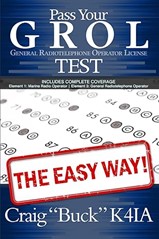
This package has the MROP overview by Captain Jack Gilbert with sample FCC test questions and a companion book by Craig “Buck” K4IA - “Pass your GROL” a great book that explains why the right answer is the right answer. Student application and testing fees are included with this package (applicants must pay a separate $35.00 issuance fee to the FCC once all requirements are met). We must have your 605E forms on file (emailed to you after purchase) with an FRN Number to schedule your in-person or online test out. Package includes shipping in the continental USA, test out and application fee(s). Only Element One needs to be consulted for this license. $125.00
FCC Elements 3 and 8 Radar Package

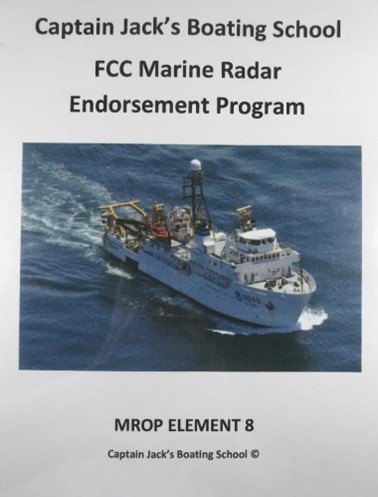
This package contains the Element 3 and Element 8 overviews by Captain Jack Gilbert with FCC sample test questions, and add-on books by Craig "Buck” K4IA - “Pass your GROL the Easy Way” a great book that explains why the right answer is the right answer for Element 3, and Bruce MacKinnon's FCC Radio Endorsement Guide, probably the best book out there on the FCC Radar Test. Student application and testing fees are included with this package (applicants must pay a separate $35.00 issuance fee to the FCC once all requirements are met). We must have your 605E forms on file (emailed to you after purchase) with an FRN Number to schedule your in-person or online test out. Package includes shipping in the continental USA, test out and application fee(s). Elements 3 and 8 must be consulted. You must hold an Element 1 MROP license or have passed the Element 1 test to obtain this license. $175.00
FCC Elements 7, 7R, and 9 GMDSS Package
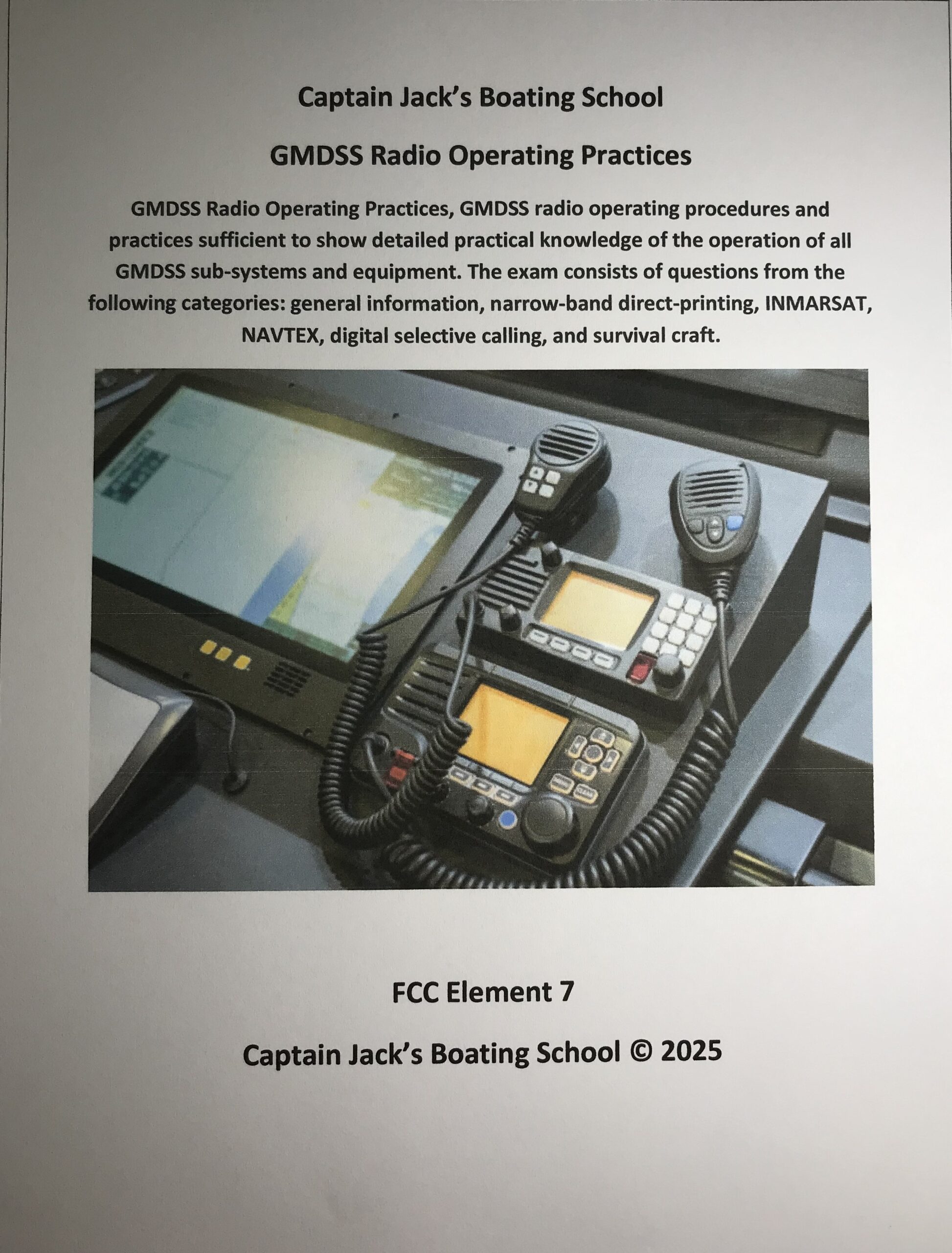

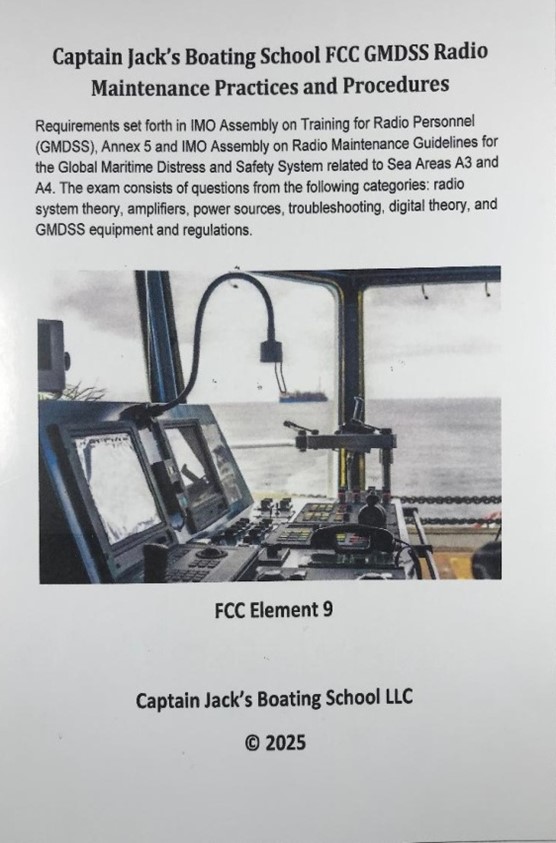
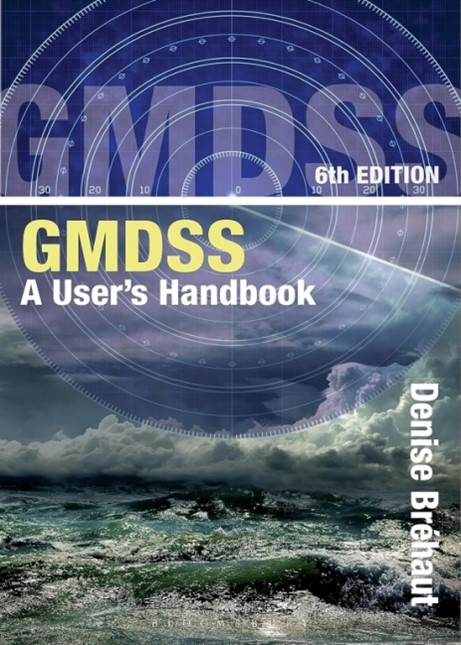
The GMDSS is an internationally recognized distress and radio communication safety system. This package contains the Elements 7, 7R, and 9 overviews by Captain Jack Gilbert with FCC sample test questions and an add-on book by Denise Brehaut "GMDSS a User's Handbook" which is the best guide out there for GMDSS. It gives clear, concise counsel on understanding the material you will be tested on and its use in a Global Maritime distress situation. Student application and testing fees are included with this package (applicants must pay a separate $35.00 issuance fee to the FCC once all requirements are met). We must have your 605E forms on file (emailed to you after purchase) with an FRN Number to schedule your in-person or online test out. Package includes shipping in the continental USA, test out and application fee(s). Elements 7, 7R, and 9 must be consulted. You must hold an Element 1 Radio License and Element 3 and 8 Radar License or have passed the tests to obtain this license. $200.00
FCC Element 6 Advanced Radiotelegraph Package
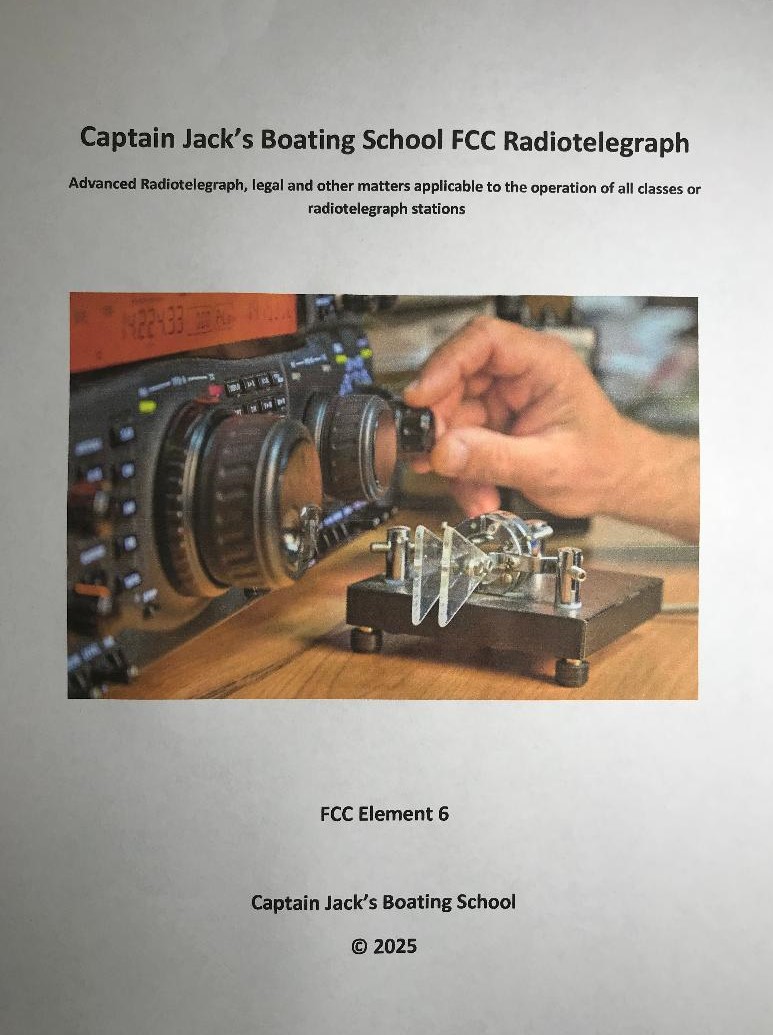
Advanced Radiotelegraph technical, legal, and other matters applicable to the operation of all classes of radiotelegraph stations. This package has the Element 6 overview and sample FCC test questions by Captain Jack Gilbert and the add-on book by Jonathan Harrison "The Ultimate Guide to Morse Code Handbook" Student application and testing fees are included with this package (applicants must pay a separate $35.00 issuance fee to the FCC once all requirements are met). We must have your 605E forms on file (emailed to you after purchase) with an FRN Number to schedule your in-person or online test out. Package includes shipping in the continental USA, test out and application fee(s). You must hold an MROP Element 1 license or have passed the MROP Element 1 test to obtain this license. $125.00
INDIVIDUAL FCC LICENSING ELEMENTS
FCC MROP Element 1 Radio
FCC Element 1 MROP Radio includes the MROP overview by Captain Jack Gilbert with sample FCC test questions and answers. Student application and testing fees are included (applicants must pay a separate $35.00 issuance fee to the FCC once all requirements are met). Includes shipping in the continental USA. $100.00
FCC Element 3 GROL
FCC Element 3 GROL includes the GROL overview by Captain Jack Gilbert with sample FCC test questions and answers. Student application and testing fees are included (applicants must pay a separate $35.00 issuance fee to the FCC once all requirements are met). Includes shipping in the continental USA. $100.00
FCC Element 6 Advanced Radiotelegraph
FCC Element 6 Advanced Radiotelegraph includes the Advanced Radiotelegraph overview by Captain Jack Gilbert with sample FCC test questions and answers. Student application and testing fees are included (applicants must pay a separate $35.00 issuance fee to the FCC once all requirements are met). Includes shipping in the continental USA. $100.00
FCC Element 7 GMDSS
Radio Operating Practices
FCC Element 7 GMDSS Radio Operating Practices includes the GMDSS Radio Operating Practices overview by Captain Jack Gilbert with sample FCC test questions and answers. Student application and testing fees are included (applicants must pay a separate $35.00 issuance fee to the FCC once all requirements are met). Includes shipping in the continental USA. $100.00
FCC Element 7R Restricted GMDSS
Radio Operating Practices
FCC Element 7R Restricted GMDSS Radio Operating Practices includes the Restricted GMDSS Radio Operating Practices overview by Captain Jack Gilbert with sample FCC test questions and answers. Student application and testing fees are included (applicants must pay a separate $35.00 issuance fee to the FCC once all requirements are met). Includes shipping in the continental USA. $100.00
FCC Element 8 Radar
FCC Element 8 Radar includes the FCC Marine Radar Endorsement overview by Captain Jack Gilbert with sample FCC test questions and answers. Student application and testing fees are included (applicants must pay a separate $35.00 issuance fee to the FCC once all requirements are met). Includes shipping in the continental USA. $100.00
FCC Element 9 GMDSS Radio
Maintenance Practices and Procedures
FCC Element 9 includes the Element 9 GMDSS Radio Maintenance Practices and Procedures overview by Captain Jack Gilbert with sample FCC test questions and answers. Student application and testing fees are included (applicants must pay a separate $35.00 issuance fee to the FCC once all requirements are met). Includes shipping in the continental USA. $100.00
Commercial Radio Operator License Program
FCC rules require that licensees of ship and aircraft stations permit only persons holding the appropriate FCC-issued commercial operator license to perform specified transmitter operation, maintenance and repair duties. To obtain a new or upgraded FCC commercial operator license, you must pass the examination administered by Captain Jack’s Boating School/NMEA.
Who Needs a Commercial Operator License?
You need a commercial operator license to operate, and/or to repair and maintain, specified ship, and aircraft radio communication stations. The licensing requirements for operating such radio stations and the licensing requirements for repairing and maintaining such radio stations are discussed separately below.
CAUTION: These listings only describe when a commercial operator license is necessary. A commercial operator license does not constitute or imply FCC authorization to transmit radio signals. Before you operate any radio station, make certain that the station is licensed as required by the FCC.
Radio Operations
You need a commercial radio operator license to operate the following:
Ship Radio Stations if:
the vessel carries more than six passengers for hire; or
the radio operates on medium frequencies (MF) or high frequencies (HF); or
the ship sails to foreign ports; or
the ship station transmits radiotelegraphy; or
the ship is larger than 300 gross tons and is required by law to carry a radio station for safety purposes.
Aircraft radio stations, except those which operate only on very high frequencies (VHF) and do not make foreign flights
You do NOT need a commercial operator license to operate the following:
Ship stations operating only on VHF frequencies that do not travel to foreign ports or make international communications (unless the vessel carries more than six passengers for hire, or the ship is larger than 300 gross tons and is required by law to carry a radio station for safety purposes)
Shore radar, shore radiolocation, maritime support or shore radionavigation stations
Survival craft stations or EPIRBs
Ship radar stations, if (a) the radar frequency is determined by a nontunable, pulse type magnetron or other fixed tune device, and (b) the radar is capable of being operated exclusively by external controls
Coast stations
Aircraft stations which operate only on VHF frequencies and do not make foreign flights
Aircraft radar sets, radio altimeters, transponders or other aircraft automatic radionavigation transmitters
ELTs or aviation survival craft stations used solely for survival purposes
Radio Maintenance and Repair
You need a commercial operator license to repair and maintain the following:
All ship radio and radar stations
All coast stations
All hand-carried units used to communicate with ships and coast stations on marine frequencies
All aircraft stations and aeronautical ground stations (including hand-carried portable units) used to communicate with aircraft
You do NOT need a commercial radio operator license to operate, repair, or maintain any of the following types of stations:
Two-way land mobile radio equipment, such as that used by police and fire departments, taxicabs and truckers, businesses and industries, ambulances and rescue squads, and local, state, and federal government agencies
Personal radio equipment used in the Citizens Band Radio Service (CBRS), Radio Control Radio Service (RCRS), and General Mobile Radio Services (GMRS)
Auxiliary broadcast stations, such as remote pickup stations
Domestic public fixed and mobile radio systems, such as mobile telephone systems, cellular systems, rural radio systems, point-to-point microwave systems, multipoint distribution systems, etc.
Stations that operate in the Cable Television Relay Service
Satellite stations, both uplink and downlink of all types
NOTE: Possession of a commercial radio operator license or permit does not authorize an individual to operate amateur or GMRS radio stations. Only a person holding an amateur or GMRS radio operator license may operate an amateur or GMRS radio station.
Additional Licensee Information
Operating While Application is Pending
A person who has filed an application for a commercial operator license with the FCC, and who holds a Proof of Passing Certificate(s) indicating that he or she has passed the necessary examination(s) within the previous 365 days, is authorized to exercise the rights and privileges of the applied-for operator license during the period before the FCC acts on the application, but only for a period of 90 days from the date the application was filed, provided that the applicant has not had a commercial radio operator license revoked or suspended in the past, and is not the subject of an ongoing suspension proceeding.
Renewal Procedures
If you need to renew a commercial radio operator license, submit completed FCC Forms 159 (Fee Processing Form) and 605. A fee is required. Current information on the fee amount and filing location can be found in the most recent edition of the Wireless Telecommunications Bureau Fee Filing Guide, FCC Form 1070Y, or by calling the Customer Support Hotline at (877) 480-3201 (select option 2 after the main menu recording).
If you file an application to renew your license before it expires, you may continue to operate under the authority of your license while the FCC processes your renewal application. However, if you fail to renew your license before it expires, you cannot operate or maintain equipment that requires that license until it is renewed. You may file to renew your expired license any time during the five-year grace period after your license expires. If you fail to renew your license within the grace period, you must apply for a new license and re-take the required examination(s).
Important Note: Prior to March 25, 2008, the license term for GMDSS Radio Operator’s Licenses, Restricted GMDSS Radio Operator’s Licenses, GMDSS Radio Maintainer’s Licenses, GMDSS Radio Operator/Maintainer Licenses, and Marine Radio Operator Permits was five years. Effective March 25, 2008, the rules were amended to extend the term of these licenses to the lifetime of the holder. Any GMDSS Radio Operator’s License, Restricted GMDSS Radio Operator’s License, GMDSS Radio Maintainer’s License, GMDSS Radio Operator/Maintainer License, or Marine Radio Operator Permit that was active, i.e., had not expired, as of March 25, 2008, does not have to be renewed, even if there is an expiration date on the face of the license document.
Posting of License or Permit
If you are employed at a station where your operator license must be posted, you may post either your proof of passing certificate or a signed copy of your renewal application instead of your license while your application for license renewal is being processed.
Lost, Stolen, Mutilated, or Destroyed Licenses
You may apply for a duplicate license by submitting FCC Forms 159 (Fee Processing Form) and 605 according to the instructions printed on the 605 application. A fee is required. Current information on the fee amount and filing location can be found in the most recent edition of the Wireless Telecommunications Bureau Fee Filing Guide, FCC Form 1070Y, or by calling the FCC’s Consumer Center toll free at 1-888-CALL-FCC (225-5322). In the alternative, a licensee can print a new license document by following the procedures for providing access to official electronic authorizations see DA 14-1846.
Name Changes
If you change your name, you must apply for a replacement license in your new legal name. Be sure to indicate the reason for your application and give both your former and new legal names.
Obtaining a License
Submit FCC Form 605 along with the appropriate original Proof of Passing Certificate(s) (for the requisite written and/or telegraphy examination element(s)) to apply for a commercial operator license. Captain Jack's Boating School will submit these documents for applicants that test with us.
There is one EXCEPTION: You do NOT have to submit a Proof of Passing Certificate when applying for a Restricted Radiotelephone Operator Permit (RR).
Use the FCC Form 605and the FCC Form 159 (fee processing form) to renew your license or to replace a lost, stolen, or mutilated license. IMPORTANT NOTE: All commercial radio operator licenses issued on or after May 20, 2013, are valid for the lifetime of the holder, and do not need to be renewed. For licenses issued before that date, see Terms of Licenses to ascertain if your license needs to be renewed.
Operating/Maintaining While Application is Pending
A person who has filed an application for a commercial operator license with the FCC, and who holds a Proof of Passing Certificate(s) indicating that he or she passed the requisite examination(s) within the previous 365 days, is authorized to exercise the rights and privileges of the applied-for operator license during the period before the FCC acts on the application, but only for a period of 90 days from the date the application was filed, provided that the applicant has not had a commercial radio operator license revoked or suspended in the past, and is not the subject of an ongoing suspension proceeding.
Term of Licenses
The following licenses are issued for the holder’s lifetime:
Restricted Radiotelephone Operator Permit
Restricted Radiotelephone Operator Permit-Limited Use
Marine Radio Operator Permit
General Radiotelephone Operator License
GMDSS Radio Operator’s License
Restricted GMDSS Radio Operator’s License
GMDSS Radio Maintainer’s License
GMDSS Radio Operator/Maintainer License
Radiotelegraph Operator License
The following licenses are valid for a 5 year term:
Third Class Radiotelegraph Operator’s Certificate
Second Class Radiotelegraph Operator’s Certificate
First Class Radiotelegraph Operator’s Certificate
These licenses may be renewed from ninety (90) days prior to the end of their term up until five years following expiration without having to re-take an examination. After the five-year grace period expires, applicants must retake the requisite written and/or telegraphy examination(s). An expired certificate is not valid for any radio operations.
Important Note: Effective May 20, 2013, First and Second Class Radiotelegraph Operator’s Certificates will be renewed as Radiotelegraph Operator Licenses valid for the lifetime of the holder, and Third Class Radiotelegraph Operator’s Certificates will be renewed as Marine Radio Operator Permits valid for the lifetime of the holder.
Examinations
To obtain an FCC commercial operator license, an applicant must submit an original Proof of Passing Certificate issued by the NMEA through Captain Jack's Boating School, or have the application filed electronically by Captain Jack's Boating School, demonstrating that the applicant has passed the required written and/or telegraphy Elements, as described below:
Type of License Elements
Radiotelegraph Operator License Written Element(s) 1 & 6
Telegraphy Element(s) 1 & 2
General Radiotelephone Operator License Written Element(s) 1 & 3
Marine Radio Operator Permit Written Element(s) 1
GMDSS Radio Operator’s License Written Element(s) 1 & 7
Restricted GMDSS Radio Operator’s License Written Element(s) 1 & 7R
GMDSS Radio Maintainer’s License Written Element(s) 1, 3 & 9
Ship Radar Endorsement Written Element(s) 8
Written Examination Elements
[Note: From time to time, the Commission may change the number of questions to be included in the examination for a particular element and/or the number of answers needed to pass the examination. The Commission will issue a public notice or take other action to inform the public of any such change.]
Element 1: Basic radio law and operating practice with which every maritime radio operator should be familiar. To pass, an examinee must correctly answer at least 18 out of 24 questions.
Element 3: General Radiotelephone. Electronic fundamentals and techniques required to adjust, repair, and maintain radio transmitters and receivers. To pass, an examinee must correctly answer 75 out of 100 questions, from the following categories:
operating procedures
radio wave propagation
radio practice
electrical principles
circuit components
practical circuits
signals and emissions
antennas and feed lines
Element 6: Advanced Radiotelegraph. Technical, legal, and other matters applicable to the operation of all classes of radiotelegraph stations. To pass, an examinee must correctly answer at least 75 out of 100 questions.
Element 7: GMDSS Radio Operating Practices. GMDSS radio operating procedures and practices sufficient to show detailed practical knowledge of the operation of all GMDSS sub-systems and equipment. The exam consists of questions from the following categories: general information, narrow-band direct-printing, INMARSAT, NAVTEX, digital selective calling, and survival craft. To pass, an examinee must correctly answer at least at least 75 out of 100 questions.
Element 7R: Restricted GMDSS Radio Operating Practices. Fifty questions concerning those GMDSS radio operating procedures and practices that are applicable to ship stations on vessels that sail exclusively in sea area A1, as defined in sections 80.1069 and 80.1081 of the Commission’s Rules. To pass, an examinee must correctly answer at least 38 out of 50 questions.
Element 8: Ship Radar Techniques. Specialized theory and practice applicable to the proper installation, servicing, and maintenance of ship radar equipment in general use for marine navigation purposes. To pass, an examinee must correctly answer at least 38 out of 50 questions.
Element 9: GMDSS Radio Maintenance Practices and Procedures. Requirements set forth in IMO Assembly on Training for Radio Personnel (GMDSS), Annex 5 and IMO Assembly on Radio Maintenance Guidelines for the Global Maritime Distress and Safety System related to Sea Areas A3 and A4. The exam consists of questions from the following categories: radio system theory, amplifiers, power sources, troubleshooting, digital theory, and GMDSS equipment and regulations. To pass, an examinee must correctly answer at least 38 out of 50 questions.
Telegraphy Examination Elements
Element 1 – 16 code groups per minute.
Element 2 – 20 words per minute.
Telegraphy exams may consist of both transmitting and receiving tests or just a receiving test. Although the FCC rules provide that passing a telegraphy receiving examination is adequate proof of an examinee’s ability to both send and receive telegraphy, the NMEA, through Captain Jack's, may nonetheless include a sending segment in a telegraphy examination. Examinees must copy by ear and, if subject to a sending test, send by hand, plain text and code groups in the international Morse code using all the letters of the alphabet, numerals 0-9, period, comma, question mark, slant mark, and prosigns AR, BT, and SK. Examinees must copy and send at the required speeds for one continuous minute without making any errors. Each test lasts approximately five minutes. The failing of any code test automatically terminates the examination. Code speeds are computed using five letters per word or code group. Punctuation symbols and numbers count as two letters each.
Examination Procedures
Use of reference materials in commercial operator license examinations is not permitted. Do not bring any books, papers, notes, study guides, or other unauthorized aids or devices to an examination.
Commercial Radio Operator Types of Licenses
Click here for full descriptions of all types of commercial operator licenses and endorsements currently issued by the FCC
Captain Jack's Boating School Provides
FCC Licensing Programs for students in the
Continental United States
(all 48 contiguous United States) including:
